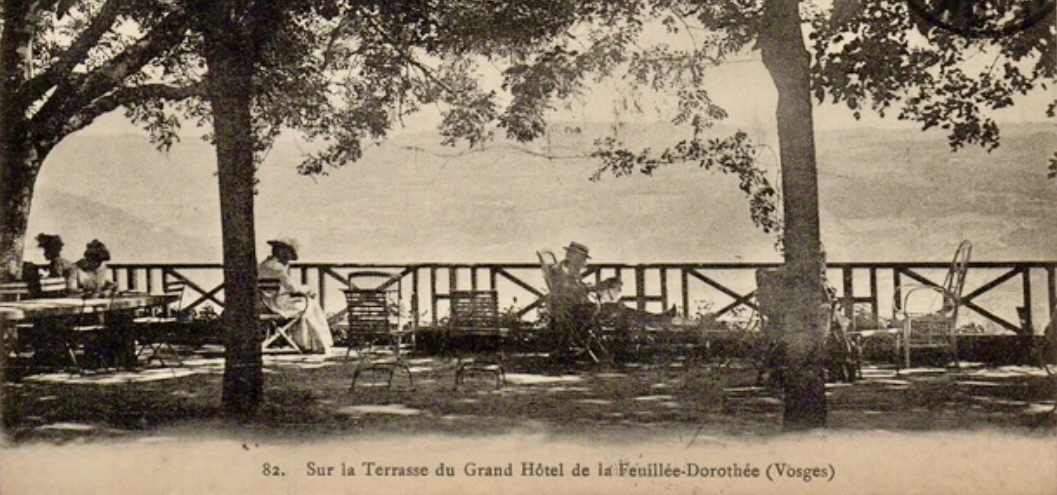
La Feuillée Dorothée and, far off, Le Val d’Ajol.
Today feels nothing like the busy, bustling days of family life I once knew.
It is also unlike the summers of my childhood, when a single day could feel intoxicating and endless.
Two memories linger most vividly.
It was a Sunday. Our family still lived in the house called Les Mousses.
In the large kitchen, the wooden table with its green-and-black speckled top bore the faint marks of the meat grinder used on that unforgettable day of the pig’s slaughter.
My notebooks lay scattered around me; I was alone.
Outside, sunlight poured into the little valley, and bees hummed busily around the plum tree.
I could hear the voices of my mother and brothers.
The sound was odd: fragmented, slightly crackling, as if the air itself hesitated. I never understood this curious distortion, which seemed to appear at the perfect moments.
All I knew was that at that instant, everything felt like pure happiness—the kind that lives in meadows, the kind everyone dreams of catching. (Paul Fort).

Sometimes, a metallic resonance drifts back into my memory, the same delicate vibration I once coaxed from my fingers on a spinet, as tenderly as a cat discovering a piano for the first time.
A distant cousin, Jules Vançon, was among the last spinet makers. My parents had a simple one, but my mother’s pride in it was immense. The ORTF—the solemn precursor to France Télévisions—even broadcast a feature on this “last keeper of tradition.” In our kitchen, fame crackled louder than the radio: my mother had Jules Vançon in the family, and that felt like a quiet, official honor.
https://epinettesetcetera.com/epinettes-des-vosges#valdajol
https://youtu.be/vtdoIagqPtE?si=at1XmvPxlN-ZhHo3
It may seem surprising that such a humble folk instrument, barely known beyond its village, could attract the attention of the legendary ORTF. The secret lay in Plombières-les-Bains. Famous spa-goers would come for the healing waters, then wander through the wooded corners called “feuillées.” There, a talented young player named Dorothée enchanted the ears of Napoleon III and Hector Berlioz. For a brief moment, the modest spinet graced Parisian salons. Trends fade, but sometimes a trace lingers… like the rustle of tissue paper.


La Feuillée Dorothée stood atop the hill overlooking the house my father had built. I saw it every day. Beyond it, Plombières no longer drew celebrities, despite its Roman-era baths—a reminder that centuries of history do not guarantee attention.

Once a year, we would visit the “trou de l’enfer,” where boiling water gushed from the ground: our local thrill. In Le Val d’Ajol, a house still bears a plaque commemorating the emperor’s stay. Every era has its own influencers.
Though spinet-making has long fallen out of fashion, it is still possible to find one today thanks to modern commerce: the cloud, online marketplaces, and flea markets. The whole family pitches in, along with the internet.
Thanks to it, I can quickly find the spinet I long for: a beautiful one, decorated with marquetry, its luthier’s signature clearly visible. One string is missing, easily replaced, though the instrument has not yet acquired the patina of age. After 125 years, time always darkens metal… and deepens memories.

Laisser un commentaire